
The breakers still pushed in. That’s not the same as working.
A Pushmatic panel from one of my inspections — built in Los Angeles, never recalled, and still something I write up every time I open one.
If your house was built in Southern California in the 1950s or ’60s, there is a fair chance the electrical panel on the outside wall looks like this one. No toggle switches. Instead, a column of rounded buttons with the amperage printed on them. You push a button once to turn a circuit off, and push it again to turn it back on.
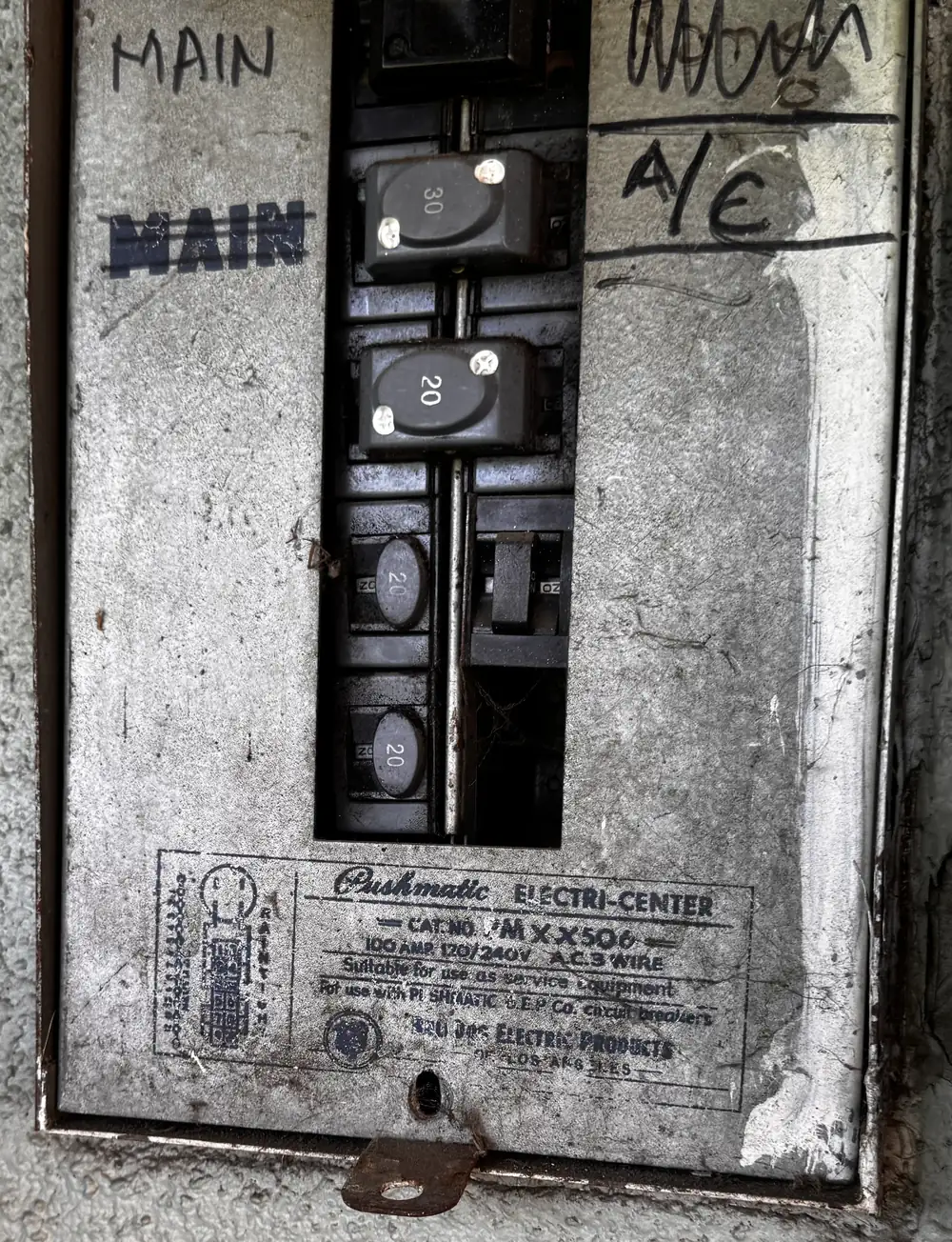
What a Pushmatic panel is
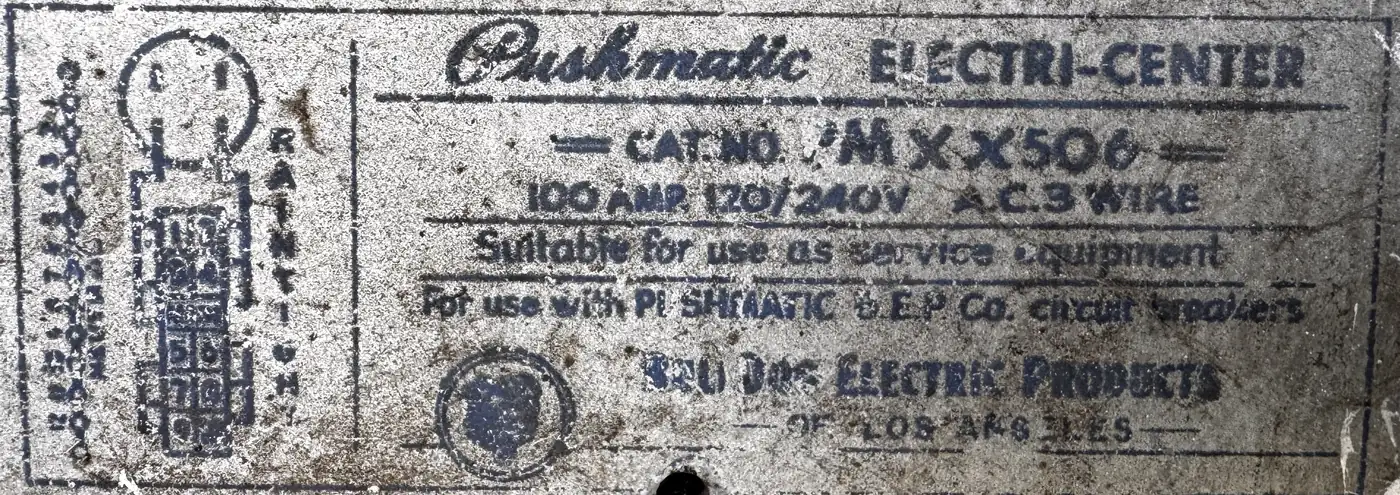
The label on this one reads Pushmatic Electri-Center, 100 amps, 120/240 volts, made by Bulldog Electric Products of Los Angeles. Bulldog’s push-button breaker design goes back to the 1930s, but panels like this went into houses mostly in the 1950s and ’60s. The product line later passed to ITE, and Siemens eventually ended up with it.
First, what it isn’t
People tend to lump every old panel together, so it is worth being precise. Pushmatic panels have never been recalled, and they are not in the same category as Federal Pacific Stab-Lok or Zinsco, which have far more serious reputations. I don’t call these out because of a known defect. I call them out because of their age and the way the breakers are built.
Why I write it up anyway
- The breakers can stiffen. The mechanism relies on grease, and breakers that go decades without being operated are widely reported to become stiff and hard to push. A breaker that has not moved since the Eisenhower administration is exactly the kind of thing you want an electrician to check, not assume.
- It is hard to tell when one has tripped. A modern toggle breaker jumps to a middle position when it trips. A push button does not give you that obvious cue, so a tripped breaker can look much like one that is on.
- Parts are getting harder. Replacement breakers are harder to find than they used to be, and electricians report that some breakers sold today do not fit older Pushmatic panels. Forcing one in is a way to damage the panel.
- Insurers ask. Some insurance companies ask about the brand and age of the electrical panel. It is better to find out how yours feels about it before you close than after.
A note on what an inspection does and doesn’t do. Standards of practice don’t have inspectors operating breakers, and I don’t flip them in somebody else’s house. So I can’t tell you whether these particular breakers will trip when they should — nobody can by looking. What I can tell you is that this is the panel where that question deserves an electrician’s answer.
What this particular panel showed
The brand was only the start. Once I looked closer, this panel had the kind of details that tell you it has been worked on over the years by more than one set of hands.
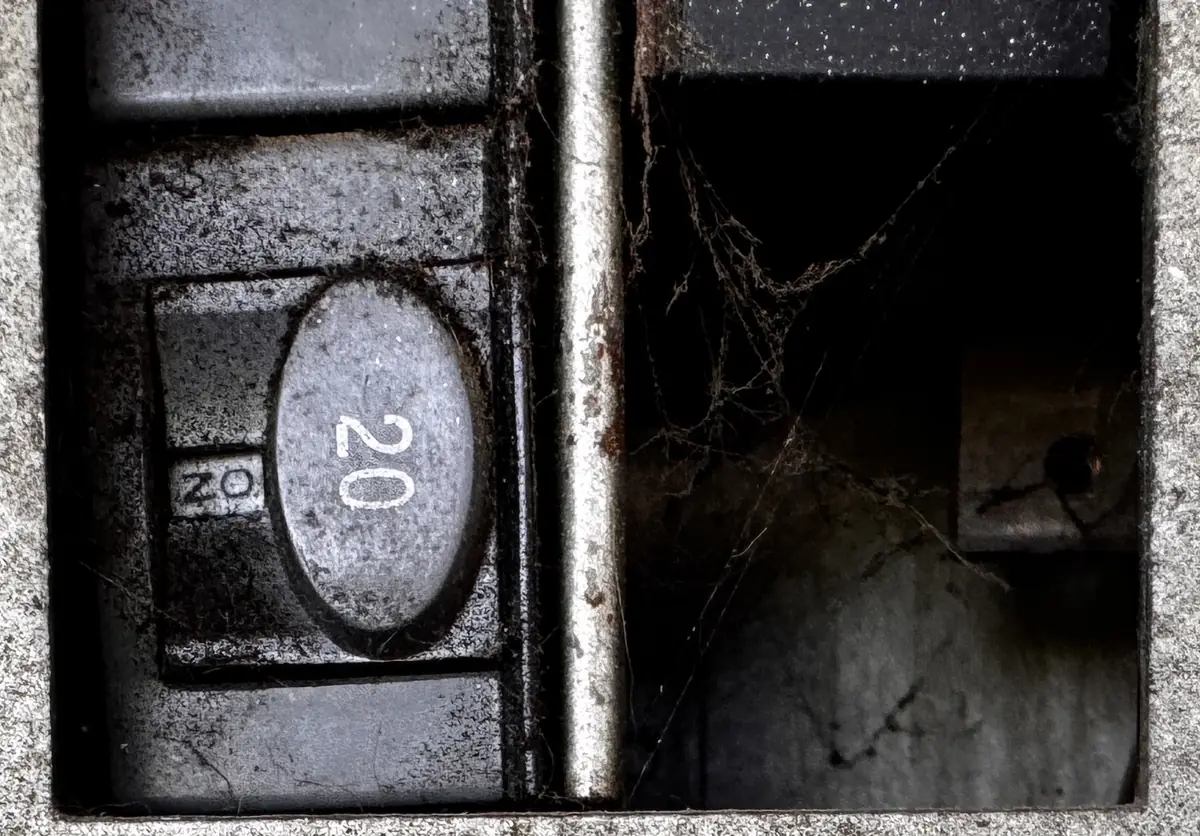
- An open breaker space. This is a call-out on any panel, whatever the brand. Every unused space in the cover is supposed to be closed off with a filler plate. An open one leaves a gap into the energized part of the panel that a finger, a tool or a curious kid can reach. The fix is a few dollars’ worth of parts, but it needs to be done.
- Relabeled by hand. The printed “MAIN” label has been crossed out and rewritten in marker, and the A/C circuit is labeled the same way. Somebody changed things around at some point. Hand labels are not a defect on their own, but they are a reason for an electrician to confirm what each breaker actually controls.
- Rust on the cover. Surface rust at the mounting tab and screw hole. It is an outdoor panel doing what outdoor panels do after sixty-odd years, and worth an electrician checking inside while they are there.
What I’d do if I were buying this house
Have a licensed electrician evaluate the panel before your contingency period runs out, and ask them to put a number on replacing it. Many buyers end up budgeting for a new panel with a house like this. That is not an emergency — plenty of these panels are still in service — but it is a known cost, and known costs are the ones you can negotiate.
If you already own one, the practical advice is simpler: don’t force a replacement breaker into it, call your insurance company if they haven’t already asked, and have an electrician look at it the next time you have one out for anything else. And if you are selling, a pre-listing inspection puts this in front of you before it shows up on the buyer’s report.
Opening the panel is part of every inspection I do. The full list of what gets looked at is under what’s included.

Rob Kruger
InterNACHI Certified Professional Inspector, with InterNACHI electrical certification, inspecting homes across Orange County, Riverside, San Bernardino and Los Angeles counties. Every inspection is done by me personally.