
The whole property, not a checklist of highlights.
Every inspection covers the same ground regardless of what you're paying. Here is exactly what gets looked at, what comes free with it, and — just as usefully — where the inspection stops.
What gets inspected
Anything that needs attention gets a photo and a plain explanation of what it means — not a code citation you'd have to look up.
-
Roof and attic
Coverings, flashing, valleys and penetrations from above; framing, ventilation, insulation depth and any evidence of past leaks from inside the attic.
-
Structure and foundation
Slab or raised, perimeter and crawlspace, posts, piers and girders, subfloor condition, and the movement patterns showing in the finishes above.
-
Exterior
Stucco, siding and trim, window and door exteriors, walkways, driveway, decks and patios, plus grading and drainage around the whole perimeter.
-
Electrical
Service entrance, panel and breakers, visible wiring, outlets and switches, GFCI and AFCI protection, and smoke and carbon monoxide alarms.
-
Plumbing
Supply and drain lines where visible, water heater and its venting and strapping, fixtures, shutoffs, water pressure and any active leaks.
-
Heating and cooling
Furnace and air conditioning operation, ductwork where accessible, filters, thermostats, condensate handling and the age of the equipment.
-
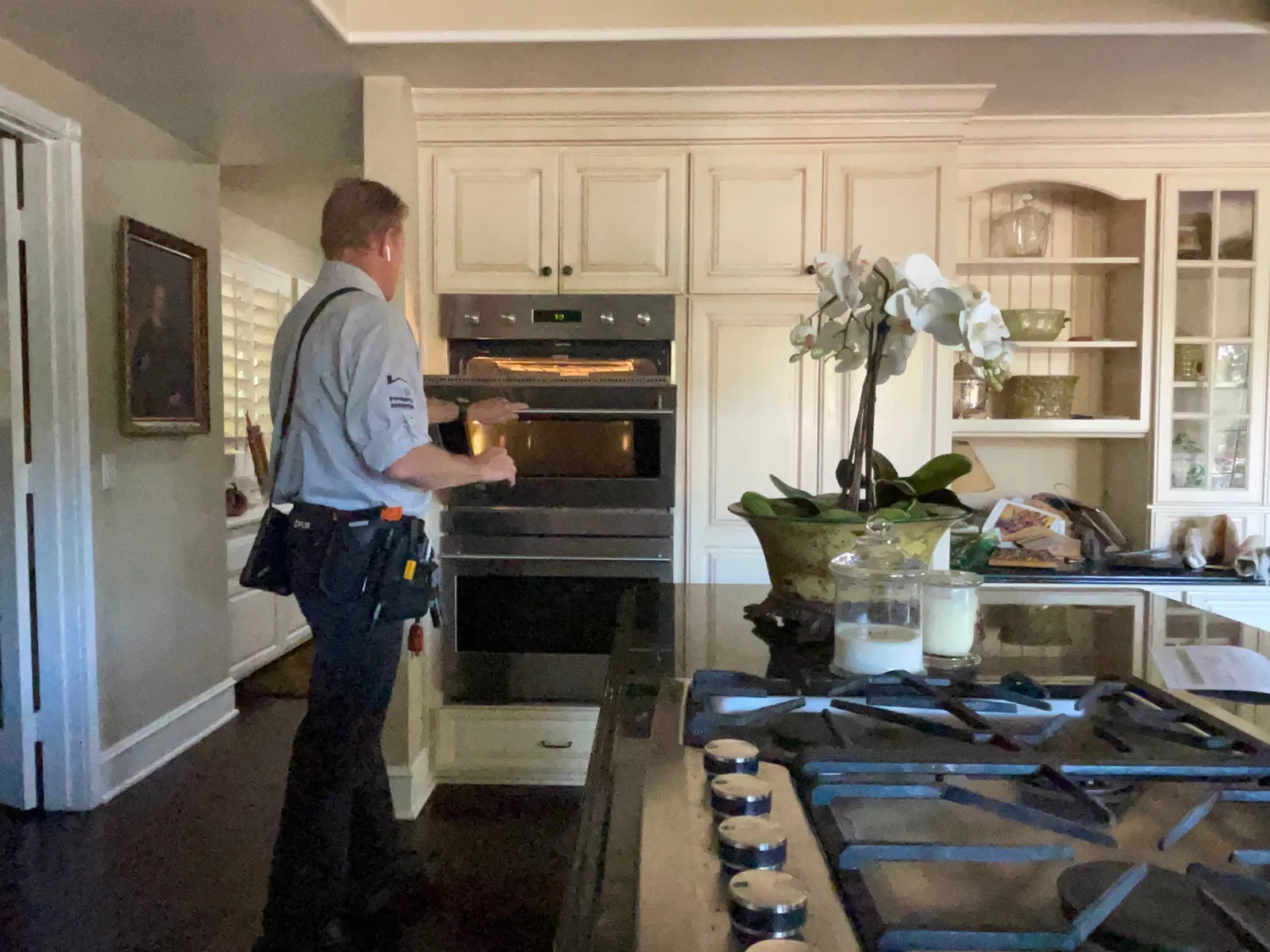
Kitchen
Built-in appliances run through a cycle, cabinets and counters, sink and disposal, vent hood, and the plumbing and electrical serving all of it.
-
Bathrooms
Fixtures, drainage, ventilation, tile and seals at tubs and showers, and the signs that tell you whether water has been getting behind them.
-
Interior rooms
Walls, ceilings and floors, windows and doors through their operation, stairs and railings, and anything that suggests movement or moisture.
-
Garage
Door operation and the automatic safety reverse, firewall separation between garage and living space, slab condition and the electrical out there.
-
Laundry
Supply connections, drainage, and the dryer exhaust run — which is a fire issue more often than people expect and easy to check.
-
Fireplace and chimney
Firebox and damper, hearth clearance, and the crown, cap and flashing where the chimney meets the roof.
Included at no extra charge
Some inspectors hold these back as add-ons and raise them on the day. I don't, because the inspection is better with them and it's easier to price one thing honestly than five things separately.
- Infrared thermal scan
- Drone roof survey where the roof calls for it
- Same-day digital report
- Walkthrough with you at the end
- Follow-up call whenever questions come up
Priced separately
Three services need equipment or time beyond the standard inspection, so they're priced on their own. Add them when you book, or afterwards.
Where the inspection stops
A home inspection is visual and non-invasive. I don't open walls, lift flooring, dismantle equipment or move a seller's belongings to reach something. That's not caution for its own sake — it's the boundary that lets an inspection happen in a day without damaging the property.
So there are real limits, and they're worth knowing before rather than after:
- Anything concealed behind a finished surface, buried, or blocked by stored goods can only be reported on by inference.
- The inspection reports condition, not code compliance. Permit history and current code questions go to the city or county.
- Where something needs a licensed specialist — a structural engineer, a roofer, a licensed contractor — that recommendation goes in the report instead of an opinion from me.
- Certain specialties require separate licensing and are referred out rather than performed.
The inspection follows the InterNACHI Standards of Practice and Code of Ethics, which set out in detail what a certified inspector is required to inspect and report on.
You're welcome to come along. Most people find the walkthrough at the end the most useful part, and it's far easier to show you a thing in the garage than to describe it in writing. If you can't be there, the report and a phone call cover it.
The certifications behind it
The scope above is what I look at. These are the reasons I know what I'm looking at. Each one is its own InterNACHI course and exam, and together they cover the major systems in the list.
-

Certified Professional Inspector
The core credential: the full home inspection standards of practice, ethics and continuing education.
-

Infrared Certified
Reading thermal images accurately, including knowing when a hot or cold spot means nothing.
-

Move-In Certified
InterNACHI’s program for homes inspected before they go on the market.
-

Roof
Roof coverings, flashing, penetrations and drainage, and how each fails.
-
Structure & Foundation
Slab and raised foundations, framing, and the movement patterns that show up in the finishes.
-

Crawlspace
The area under raised homes: supports, moisture, ventilation and access.
-

Electrical
Service, panels, branch wiring and the defects that create shock and fire risk.
-

Plumbing
Supply and drain systems, water heaters, fixtures and the materials that don’t last.
-

HVAC
Heating and cooling equipment, ductwork, venting and combustion safety.
-

Stucco
Cracking, detailing and moisture behind stucco, the most common cladding in Southern California.
-

Moisture Intrusion
How water gets into a building, how it travels, and tracing it back to the source.
-

Pool & Spa
Shells, decks, circulation equipment, heaters, bonding and safety barriers.
-

Multi-Unit Housing
Shared systems, separations between units and the issues specific to income properties.
-
Four-Point
The insurance-focused review of roof, electrical, plumbing and HVAC.
-

Kitchen
Built-in appliances, venting, plumbing and electrical at the counters.
-

Garage
Door operators and safety reverse, fire separation, and the slab and framing.
-

Chimney
Fireplaces, chimneys, flues and the clearances that keep them safe to use.
-

Drone Pilot
Flying roofs safely and capturing images close enough to judge their condition.
Questions about scope?
Call before you book rather than after. If your property has something unusual — a detached structure, a well, solar, a converted garage — tell me and I'll say up front what I will and won't be able to cover.