
The ceiling looked fine. The camera disagreed.
There was nothing wrong with this ceiling that anyone could see. I scanned it anyway, because I scan all of them — and found two bays where the insulation had never been put back.
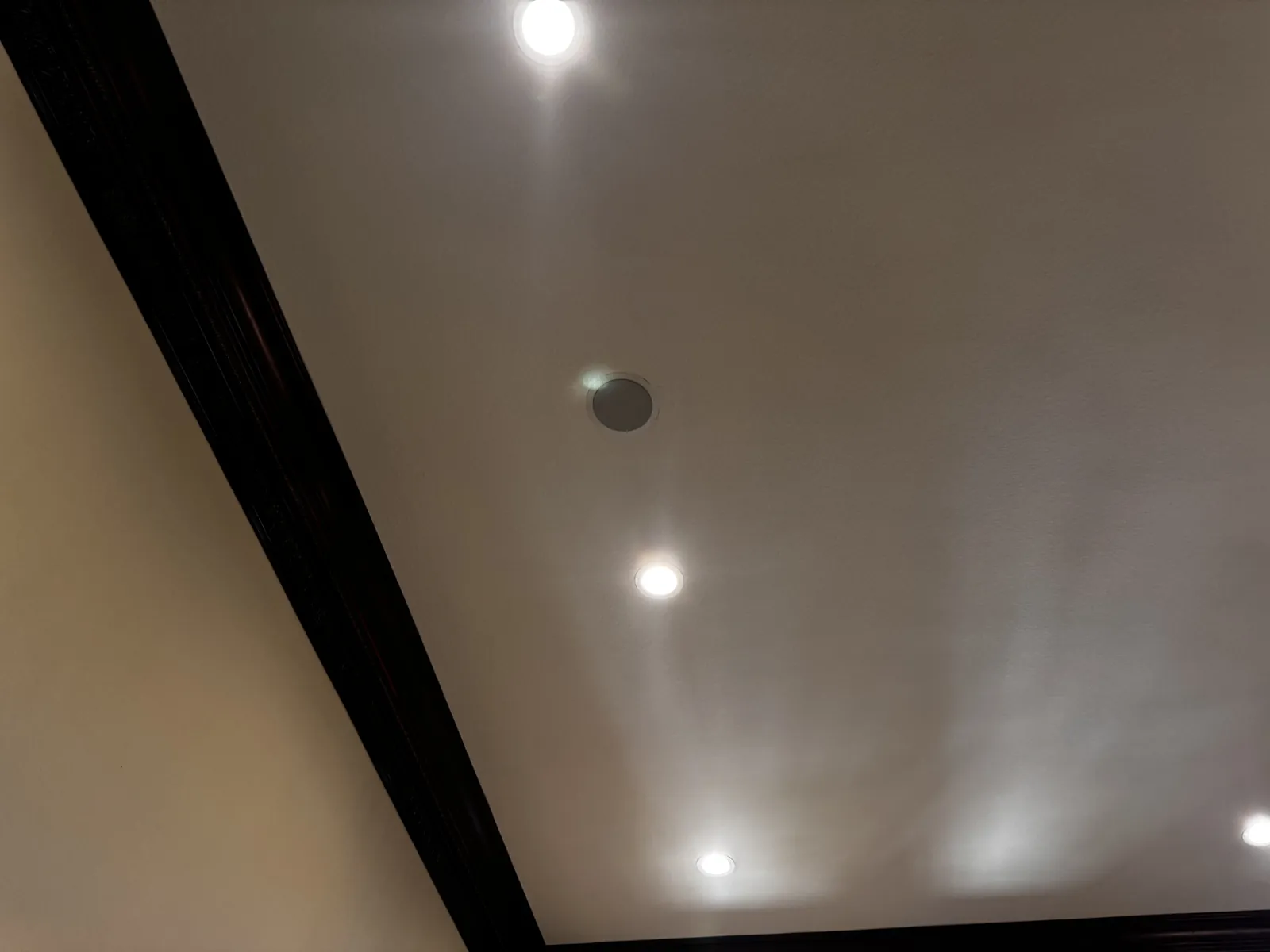
This is a ceiling from a home I inspected. Recessed can lights, a flush-mounted speaker, dark crown molding, flat paint in good condition. No stains, no sagging, no cracking. If you walked the room with a flashlight — which is what a visual inspection is — you would write nothing down.
Then I pointed the infrared camera at it
Nothing about this ceiling prompted the scan. I run the camera across ceilings, walls and around windows on every inspection as a matter of routine, the same way I open every electrical panel. The findings that matter are usually the ones nobody asked me to look for.
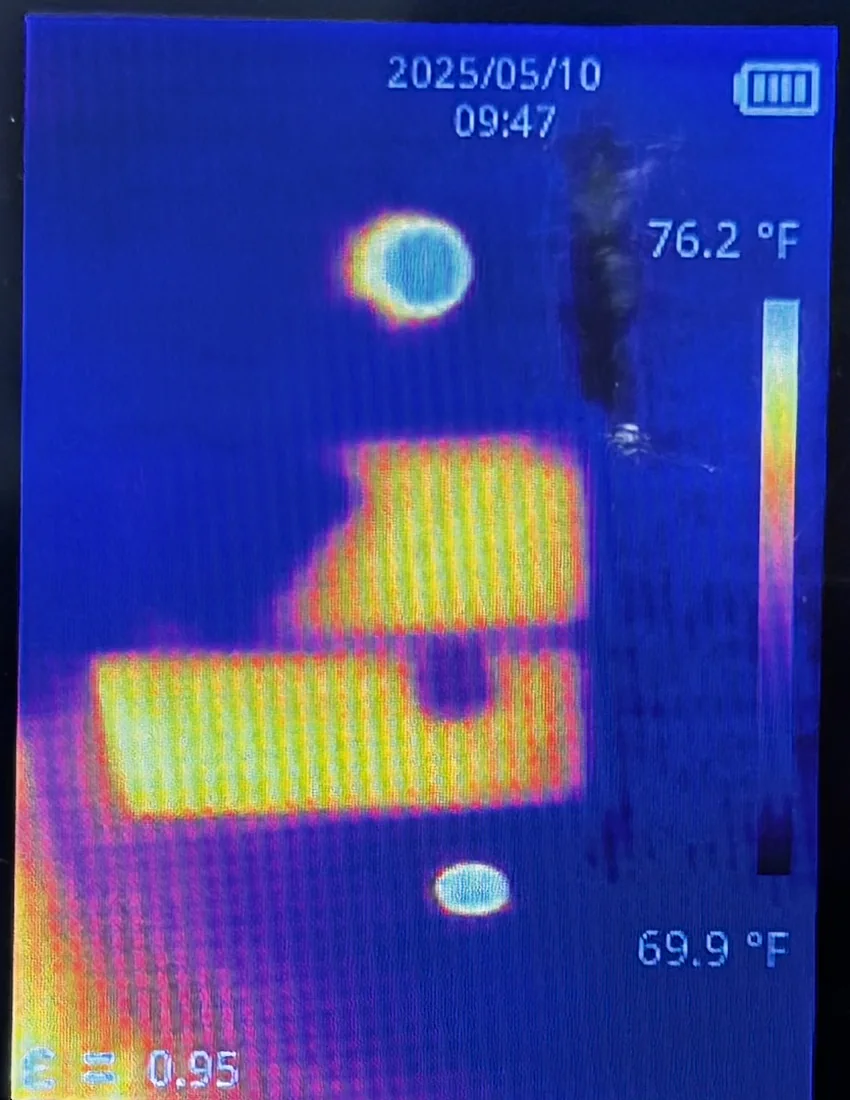
Blue is the insulated ceiling, doing its job at about 70°F. The two yellow rectangles are roughly 76°F — six degrees of attic heat coming through the drywall in a pair of neat, straight-edged blocks. The round spots are the light fixture and the speaker, which read their own temperature rather than the ceiling's. That is the first thing to learn about these images: you read the shapes, not just the colors.
The shape is the diagnosis
A temperature difference on a ceiling has a short list of likely causes, and the outline tells you which one you are looking at.
- Water spreads. A plumbing or roof leak produces an irregular blob with soft, feathered edges. It runs downhill, it pools where framing stops it, and it rarely respects a straight line.
- Framing is thin and repetitive. Joists and studs show as evenly spaced narrow stripes across a whole surface — normal, and not a defect.
- Missing insulation is rectangular. It takes the shape of whatever it is missing from. Joist bays are rectangles, so the gap is a rectangle, with hard edges where the remaining batt begins.
These two blocks have crisp edges and square corners, they sit side by side at joist-bay width, and they are warmer than everything around them rather than cooler. That is missing insulation, and it is not a close call.
This is why the credential matters more than the camera. Any inspector can buy an infrared camera and photograph a colored blob. Knowing that a hard-edged rectangle is an insulation gap and a soft-edged smear is water — and that a shiny surface in sunlight is neither — is the part that takes training. It is what the InterNACHI Infrared Certified credential is for.
What actually happened up there
Somebody installed can lights in a finished ceiling. To cut the holes and wire the housings, they pushed the insulation batts out of the way from below, and when the lights were in, they never went back into the attic to put the insulation back. The lights work perfectly. Nobody has any reason to suspect a thing.
This is one of the most common findings I have in Southern California housing stock, and it comes up over and over again in any home where lighting, speakers, bathroom fans or ductwork were retrofitted after the house was built. The trade that opened the ceiling is almost never the trade responsible for closing the insulation back up, so it falls through the gap between them.
Why a buyer should care about six degrees
Six degrees on a mild May morning sounds like nothing. Consider where the number comes from. That heat is coming out of an attic, and a Southern California attic in August does not sit at 76°F — it sits well north of 130°F. The same two bays that leak six degrees in spring leak considerably harder in summer, straight into the room below, all day, every day, for as long as the gap is there.
In practice it looks like the bedroom that never gets comfortable, the thermostat nobody agrees on, and an air conditioner running longer than it should. Owners usually blame the HVAC system. Often it is not the HVAC system.
The good news is that this is near the bottom of the list of expensive findings. It is an afternoon in the attic and some batt insulation — no permits, no trades coordination, no drywall opened up. For a buyer it is the kind of item worth knowing about precisely because it is so cheap to put right; for a seller doing a pre-listing inspection, it is the kind of thing worth fixing before anyone else writes it on a report.
The honest limits of this
I would rather be trusted than impressive, so: the camera did not see through the ceiling. It measured the surface of the drywall and nothing more. The insulation gap was visible only because the attic was warmer than the room, which gave the drywall something to report.
That scan was taken at 9:47 in the morning in May, with emissivity set at 0.95 for painted drywall. A mild morning is not the ideal condition for this — had the house been closed up on a 100°F afternoon, those rectangles would have been far more dramatic. And on a genuinely mild day with the HVAC off and little temperature difference either side of the ceiling, I might have seen nothing at all. A clean infrared scan in those conditions proves very little, and I will say so in the report rather than let it read as a clean bill of health.
That is the trade-off with this tool. It is very good at showing me where to look, and it is not a substitute for looking. Every infrared image in my reports sits next to an ordinary photo of the same spot, so you can see which wall, which corner, and how far it runs — because on its own, a thermal image is a colored rectangle that means nothing to anyone but me.
It comes with the inspection
Plenty of inspectors sell thermal imaging as an upgrade, and I understand why — the equipment is not cheap. I include it on every inspection instead, along with the drone roof survey, because a finding like this one is invisible without it and it feels wrong to make finding it optional. You do not have to ask for it or decide whether it is worth the money. The camera comes with me.
More on what infrared can and cannot do is on the thermal imaging page, and everything a standard inspection covers is listed under what's included.

Rob Kruger
InterNACHI Certified Professional Inspector and Infrared Certified Thermographer, inspecting homes across Orange County, Riverside, San Bernardino and Los Angeles counties. Every inspection is done by me personally.